What UK payment data reveals about cash flow
New data shows shorter waits and low write-offs, yet late payment still absorbs cash and spreads through supply chains says Lars Holdgaard, Founder of Debitura.
The UK’s payment picture is not simply getting better or worse. Recent figures show modest improvement in how quickly small businesses are paid, while also revealing how widely late payment still disrupts day-to-day cash flow.
Debitura’s UK Collection Report brings together current evidence on payment behaviour and recovery. Its clearest finding is that late payment is often less about invoices becoming permanent losses than about otherwise viable businesses being forced to carry the delay.
Small-business payment time edged down
Xero’s monthly data shows that UK small businesses waited an average of 29.3 days to be paid in June 2026, including 8.3 days beyond the due date. A year earlier, those figures were 29.6 days and 9.2 late days.
That is welcome progress, particularly in the fall in late days. But an average delay of more than a week still matters to a small company paying wages, tax and suppliers on fixed dates.
Other evidence shows the scale of the remaining gap. CRIBIS recorded 60.5% of UK companies paying B2B invoices on time in the final quarter of 2025. That still leaves a substantial share of companies outside the on-time category.
Late payment travels through the supply chain
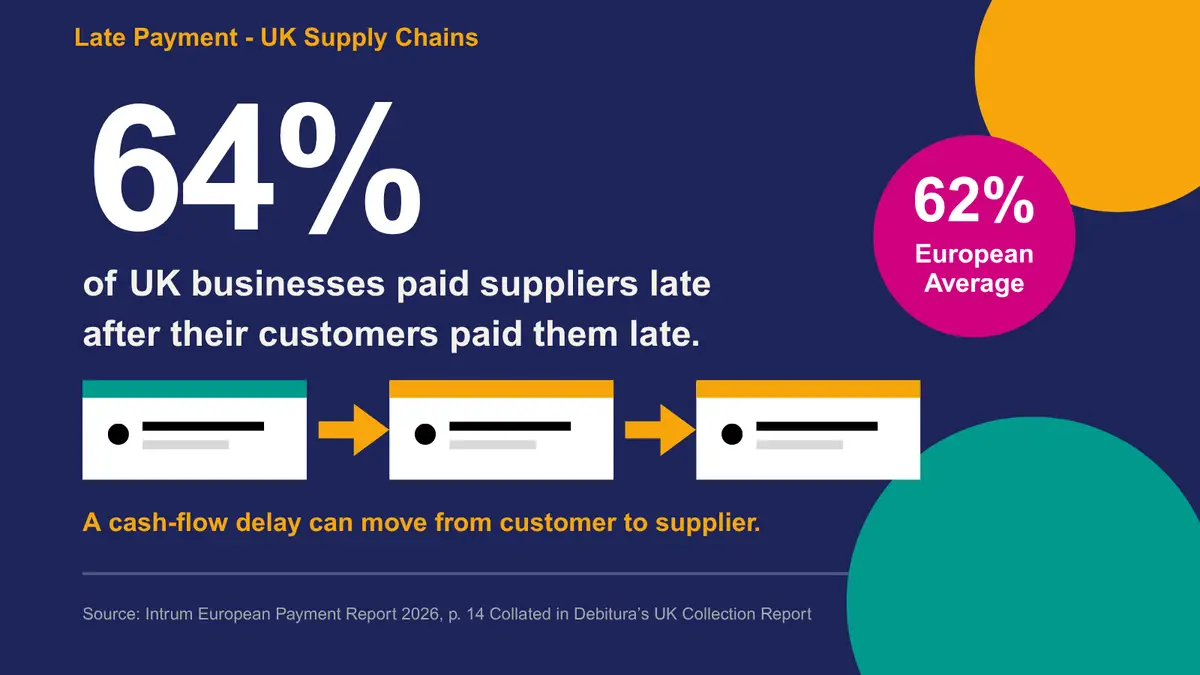
The strongest warning in the data is what happens next. Intrum’s 2026 survey found that 64% of UK businesses had paid their own suppliers late because customers paid them late. The European average was 62%.
This turns late payment from a dispute between two firms into a chain reaction. A delayed customer payment can become a delayed supplier payment, placing the greatest strain on businesses with the least room to absorb it.
Intrum also found that 13.01% of UK business revenue was paid late. Respondents put the sustainable level at 13.16%. The narrow margin suggests that payment delays are operating close to the limit businesses believe they can carry without putting financial stability at risk.
Late is not always lost
The recovery picture is more encouraging. Atradius found that 34% of UK respondents had no overdue B2B invoices, compared with 23% across Western Europe. It also found that 61% wrote off less than 0.5% of annual B2B sales as bad debt.
The distinction matters. A late invoice may eventually be paid, yet still cause real damage while it remains outstanding. It can restrict hiring, investment and stock purchases, or force a business to use borrowing for costs that would otherwise have been covered by trading income.
Better rights still need better payment behaviour
The Commercial Payments Bill introduced to Parliament proposes maximum payment terms, mandatory interest and stronger powers for the Small Business Commissioner. Clearer rules could reduce the imbalance that makes small suppliers reluctant to challenge larger customers.
The findings suggest that enforcement should be judged not only by whether bad debt falls, but also by whether payments arrive closer to the agreed date and fewer businesses have to pass delays to their own suppliers.
For an individual small business, one practical measure follows from the data: track both total time to payment and days paid late. A falling loss rate can hide a growing cash-flow burden. Recording due dates, disputed invoices and broken payment promises makes it easier to spot that pressure early and decide whether specialist UK debt collection support is the next proportionate step.
The findings contain grounds for optimism, but not complacency. Xero’s small-business payment times edged in the right direction, while many Atradius respondents reported limited write-offs. The unresolved problem is the working capital trapped in between, and the pressure it passes from one business to the next.
Author bio

Lars Holdgaard is the founder of Debitura and has more than 10 years of experience across debt collection, accounts receivable, technology and startups. He previously built software for financial administration and receivables management.