Late Payments Bill: What it could mean for your business
The government has introduced landmark legislation to tackle late payments and support small businesses across the UK.
The Commercial Payments (Late Payments) Bill proposes the most significant reforms to payment practices in over 25 years, aiming to ensure businesses are paid on time and to strengthen accountability across supply chains.

The Late Payments Bill is currently progressing through Parliament.
Details may change before it becomes law. This page will be updated as the Bill develops.
Stay informed as the Bill progresses
Why this Bill matters
Late payments remain a major challenge for businesses across the UK.
Every year, they cost the economy £11 billion and result in thousands of business closures. For many business owners, the impact is immediate, affecting whether they can pay staff, cover costs, and invest in growth.
This Bill aims to address those challenges by introducing stronger protections and clearer expectations around how businesses pay each other.
It represents what has been described as the toughest crackdown on late payments in a generation, designed to support small businesses and improve cashflow across supply chains.
Businesses spend 86 hours chasing late payments
With an average 38 businesses closing every day as a result of late payment
What is included in the Bill
60-day payment terms
The Bill proposes introducing a maximum payment term of 60 days for large businesses paying smaller suppliers, with limited exemptions.
Interest on late payments
Interest on late payments would become mandatory, making late payment no longer cost-free.
Time limit on disputes
A defined timeframe for raising invoice disputes is proposed, aiming to prevent delays caused by late challenges.
Stronger enforcement
The Small Business Commissioner would be given expanded powers to investigate, adjudicate disputes and take enforcement action.
Banning retentions in construction
The legislation would ban the deduction and withholding of retentions under a construction contract to prevent loss through insolvency and unfair payment practices.
Why this is a significant change
The Bill gives us the strongest legal framework on late payments in the G7.
It aims to:
- improve cashflow across supply chains,
- reduce the burden of chasing payments,
- support business growth and productivity,
- create a fairer and more transparent payment culture.
By reducing late payments, these reforms would help businesses focus on growth, investment and creating jobs.
What this could mean for your business:
Small Businesses
Know your rights
Greater certainty and protection
- Provide clearer expectations around when you should be paid,
- Strengthen protections against late or delayed payments,
- Improve access to support when disputes arise.
Large Businesses
Get ready
Changes to payment practices and oversight
- Change how payment terms are set and applied,
- Increase transparency around payment performance,
- Place greater emphasis on governance and accountability for payment practices.
Where the Bill is now
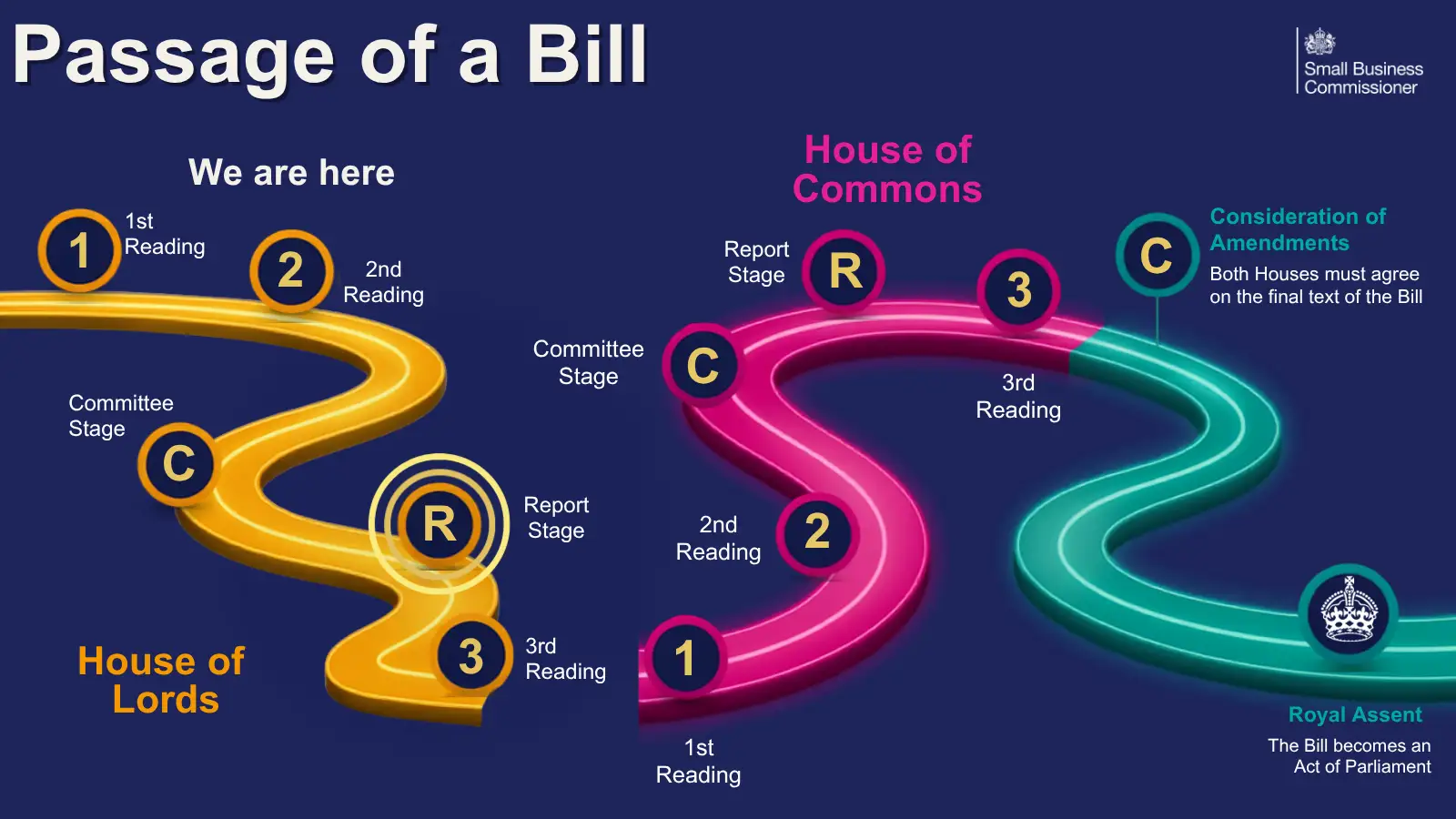
At this stage Peers consider amendments made during Committee Stage and debate any further changes before the Bill moves forward.
For more information on how a bill becomes a law follow this link
FAQ
New Small Business Commissioner Powers
Referrals to adjudication are confidential and designed to resolve disputes in an amicable way. Where businesses report persistent late payment, the Commissioner is under a duty to maintain the confidentiality of the supplier and can act on anonymous information. These investigations could lead to serious fines under the new powers proposed in the Bill.
If you run a small business in the UK and have an unresolved payment dispute with a larger customer, you can already contact the Small Business Commissioner’s office for support and advice. After the Bill becomes law, small businesses will have a legal right to adjudication to ensure a swift and fair resolution to payment disputes.
At the moment most larger businesses either contract out of paying interest on late payments or they simply refuse to pay. However, the Bill will change this making late payment interest at 8% above the bank of England base rate compulsory. If businesses pay late, they will need to pay all the interest and compensation due. Failure to do so is grounds to be taken to adjudication and persistent failure is grounds for an investigation, the cost of these will be borne by the larger business if they are in breach.
The Office of the Small Business Commissioner is currently a small but highly effective team. To prepare for the additional responsibilities set out in the Bill, the Commissioner has been working closely with colleagues in the Department for Business to ensure the organisation has the resources needed to deliver the new powers effectively. Recruitment is already underway to expand the team, and investment is being made in improved systems and processes to ensure additional cases can be managed efficiently.
E-Invoicing
HMRC are leading on the government’s e-invoicing policy, but we are well linked into those discussions. Those who use digital systems get paid faster so we are very supportive of the Government’s approach and will continue to keep an eye on this important policy area. Our message to businesses large and small is that e-invoicing will help you be compliant with the new laws and get paid quicker.